What's Really Behind Burning, Tingling Feet at Night — and the Okinawan Turmeric Ritual People Are Talking About
If your feet burn and tingle the moment the lights go out, you are not imagining it — and you may have been looking at the wrong cause. Here is what researchers are now studying about nerve health, and the simple Okinawan turmeric ritual thousands are exploring.

 ▶ Tap here to watch the free interview
A growing number of readers say a simple morning turmeric ritual changed how their feet feel at night.
If you are reading this at 2 or 3 in the morning because your feet feel like they are burning over an invisible fire, you are not alone — and you are not imagining it.
You know the feeling no one else seems to understand. The tingling that crawls up your legs. The sudden electric jolts. The numbness that makes you afraid you will stumble because you simply cannot feel the floor under your feet. The nights soaking your feet in cold water, just begging for a few minutes of quiet so you can sleep.
And here is the part that makes it worse: if you have already tried the prescriptions, the creams, the supplements — and felt let down every time — there may be a reason for that. One that has nothing to do with how hard you tried, and that your doctor may have never explained to you.
Already curious? Watch the full interview →Free to watch · about 20 minutesThe factor researchers say most people overlook
For years, burning and tingling feet were written off as an unavoidable part of getting older or living with diabetes. But a wave of newer research has pushed scientists to look somewhere else entirely: at the thin protective layer that wraps around every nerve, called the myelin sheath.
Think of it as the rubber coating around an electrical wire. When that coating gets stripped, the "wires" short-circuit — and instead of sparks, you feel burning, stabbing, and numbness. So the real question becomes: what is stripping it?
According to researchers, the chain looks something like this:
- Everyday toxins — found in much of the modern food supply and in plastics — quietly build up in the body
- They appear to block the key B vitamins your nerves depend on, so taking more vitamins alone often changes nothing
- Starved of those vitamins, the body produces high levels of an enzyme some researchers nickname "acid for the nerves"
- That enzyme wears down the myelin and leaves behind a sticky residue that coats and chokes the nerve — a kind of "sticky plaque"
- The result is the burning, tingling and numbness — and, left alone, it tends to compound over time
That single idea — that the problem is not "you," but something quietly interfering with your nerves — is exactly why a discovery from a small chain of islands in Japan has been spreading by word of mouth among people who thought they had tried everything.
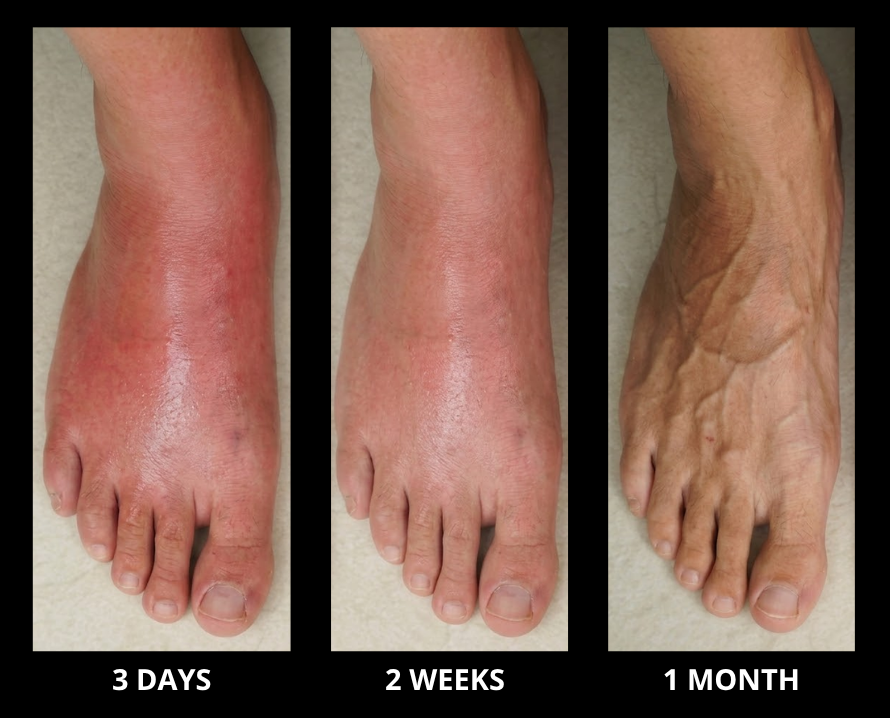 ▶ Click here to watch now
In the interview, the researcher walks through the full "nerve reset" ritual — the exact ingredients and the order he recommends — step by step.
WATCH THE FREE INTERVIEW Free · about 20 minutesEducational interview · results are not typical
The islands where nerve pain is almost unheard of
Okinawa, Japan, is famous for one of the longest-living populations on earth — and for something researchers find remarkable: reports of neuropathy and nerve disease there are strikingly rare.
One thread keeps coming up: the turmeric grown in Okinawa. Unlike the turmeric most people have in a kitchen cabinet — which typically contains only 2–3% curcumin — Okinawan turmeric is reported to carry a far higher concentration. Curcumin has been studied for its role in supporting nerve health, and that difference is why so many people are now paying attention to it.
A Nobel Prize–winning researcher recently described combining this specific turmeric with a few supporting nutrients into a simple morning routine he calls a "nerve reset." The idea, as he explains it, follows three plain steps:
- Help the body clear out everyday toxins that may interfere with key nerve vitamins
- Allow those vitamins to be absorbed again, the way they should be
- Support the body's own repair of that protective nerve coating
Some are calling it the simple, natural turmeric recipe for the nerves they wish they had found years ago. He lays out the full step-by-step ritual — the exact ingredients, the amounts, and the order he recommends — in a recorded interview that has been circulating online.
Watch the full step-by-step interview →Free to watch · turn your sound onWhy nothing seemed to work before
If you have taken vitamin B supplements and felt no difference, there may be a simple explanation. Some researchers compare it to trying to fill a bucket with holes in the bottom — if the body cannot hold on to those nutrients in the first place, swallowing more of them changes little.
That single idea has been an "aha" moment for a lot of people. It reframes years of frustration not as personal failure, but as a missing piece nobody had explained to them.
What readers are saying



None of this is a promise, and results naturally vary from person to person. But for anyone who has spent another night with their feet on fire, the explanation alone is worth a few minutes of your time.
Don't spend another night just wondering. See the full step-by-step "nerve reset" ritual explained by the researcher in the interview.
WATCH THE FREE INTERVIEW NOWFree to watch · results are not typical